Spray Dryer Explosion Risks and Explosion Relief Solutions for Industrial Safety
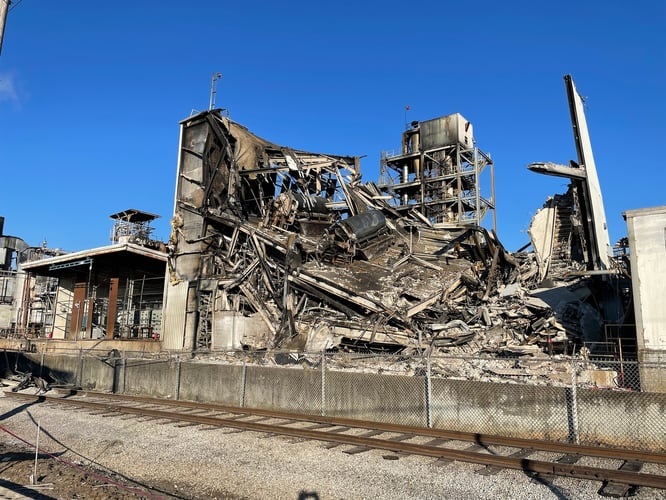
Table of Contents
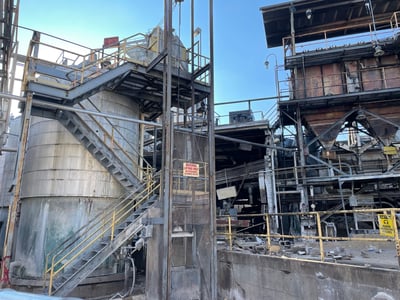
When combustible dust reaches the right concentration inside an enclosed space and meets an ignition source, the result can be an explosion. In most manufacturing environments, the goal is to eliminate airborne dust. In spray drying, however, the process is specifically designed to create it.
That’s what makes spray dryers uniquely hazardous — and why facilities must understand the explosion risks and implement engineered protection, including properly sized explosion relief doors and vents.
How the Spray Drying Process Works
Spray drying was originally developed in the late 1800s to produce powdered milk. Today, it is widely used across food processing, pharmaceuticals, chemicals, and specialty materials manufacturing.
The process typically involves two main stages:
- A wet slurry is atomized into a fine mist at the top of a drying chamber.
- Heated air or gas — often between 400°F and 1,000°F — evaporates moisture, leaving fine airborne powder particles.
The dry particles are then transported to a separator, commonly a cyclone, where the powder is removed from the air stream before packaging or further processing.
This process inherently creates a suspended cloud of fine particulate matter — exactly the condition required for a dust deflagration if an ignition source is present.
Why Spray Dryers Present a High Explosion Risk
Not all powders are combustible, but many food, agricultural, chemical, and pharmaceutical materials are.
According to NFPA definitions, combustible dust typically consists of particles smaller than 0.420 mm in diameter. At that size, particles disperse easily in air and form a fuel-air mixture.
When dispersed inside a confined vessel such as a spray dryer:
- The dust acts as pre-mixed fuel
- Heated air provides oxygen
- Numerous potential ignition sources may exist
If the concentration falls within the explosive range and ignition occurs, a deflagration can propagate rapidly through the chamber.
Spray dryers are particularly vulnerable because:
- They operate at elevated temperatures
- They intentionally atomize materials into fine particles
- They contain enclosed volumes
- They often connect directly to cyclones or dust collectors
Preventing Spray Dryer Explosions
Prevention focuses on eliminating ignition sources and minimizing dust accumulation.
Ignition Source Control
Common ignition sources include:
- Static electricity buildup
- Electrical faults
- Friction in mechanical components
- Overheated bearings
- Sparks or embers from combustion systems
Proper grounding, bonding, bearing maintenance, and burner system design are essential.
Equipment Design Considerations
Spray dryers should be designed with:
- Smooth internal surfaces to prevent dust buildup
- Minimal ledges or structural areas where material can accumulate
- Proper airflow management
- Routine cleaning and inspection protocols
Even with strong preventive controls, however, the risk cannot be reduced to zero.
Why Explosion Mitigation Is Critical
Because spray drying inherently produces combustible dust clouds, explosion mitigation must be part of the design strategy.
Key mitigation elements may include:
- Pressure detectors in the dryer and separator
- Flame detection systems
- Automatic shutdown controls
- Isolation valves between dryer and cyclone
- Explosion suppression systems
- Explosion relief doors and vents
When a deflagration occurs, pressure rises extremely fast. If the vessel cannot relieve that pressure quickly, structural rupture can occur.
How PSD Explosion Relief Doors Help Protect Spray Dryers
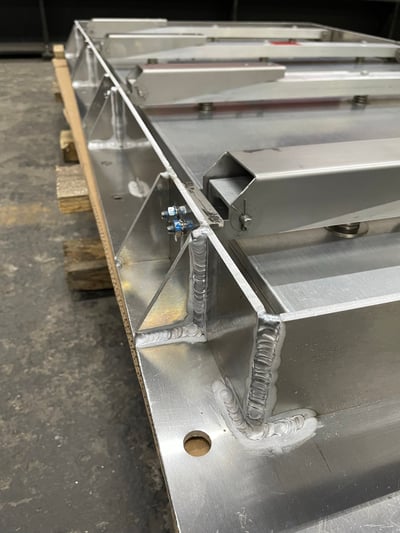
Philadelphia Safety Devices (PSD) manufactures reusable explosion relief doors designed to open rapidly at calibrated overpressure setpoints.
In spray dryer applications, properly engineered explosion relief:
- Reduces peak internal pressure
- Protects the drying chamber and cyclone
- Directs expanding gases to a safe location
- Helps prevent structural failure
- Improves personnel safety
PSD explosion relief doors are engineered to open at low preset pressures and respond in milliseconds. Unlike single-use rupture panels, they are reusable and recalibratable, helping reduce downtime and lifecycle costs.
Correct sizing and placement — often guided by NFPA 68 venting calculations — are essential to ensure the system can manage the potential pressure rise inside the dryer.
Planning for Spray Dryer Explosion Events
Facilities operating spray dryers should develop comprehensive safety plans that include:
- Operator training
- Startup and shutdown procedures
- Maintenance schedules
- Emergency response protocols
- Engineered explosion mitigation
Spray drying will always involve combustible dust risk. The goal is not just prevention — but preparation.
Protecting Your Spray Drying Operation
Spray dryers are efficient and widely used, but they operate under conditions that make dust deflagration possible.
With proper design, monitoring, and engineered explosion relief from PSD, facilities can significantly reduce the severity of a potential event.
If your operation includes spray drying equipment, reviewing your explosion protection strategy is a critical step in protecting your equipment, your facility, and your workforce.