Explosion Relief Devices Explained: Doors, Vents & Vacuum Relief Valves
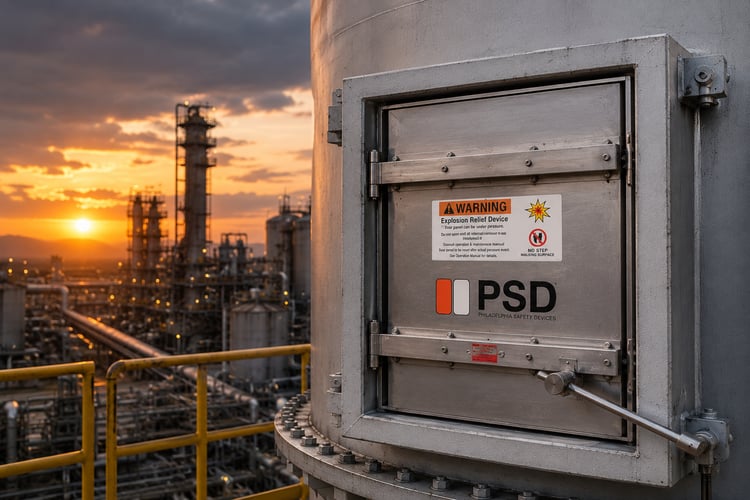
Table of Contents
Choosing the Right Explosion Relief Device for Your Application
Introduction
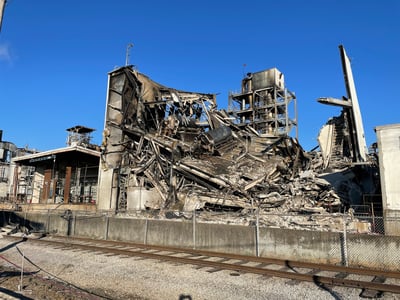
Explosion relief devices play a critical role in protecting industrial equipment, facilities, and personnel from the dangers of overpressure events. When combustible dust, gases, vapors, or process upsets create excessive pressure within a vessel, explosion relief devices provide a controlled method for releasing that pressure before catastrophic damage occurs.
Selecting the right explosion relief device requires understanding how each technology works, where it performs best, and what regulations govern its use.
This guide explains the most common types of explosion relief devices and how manufacturers determine which solution is appropriate for their application.
What Is an Explosion Relief Device?
An explosion relief device is a safety mechanism designed to open, rupture, or release at a predetermined pressure.
The purpose of the device is to:
- Reduce internal vessel pressure
- Protect equipment from structural failure
- Minimize damage during an explosion event
- Improve facility safety
- Support compliance with applicable safety standards
Explosion relief devices are commonly used in industries such as:
- Chemical processing
- Food manufacturing
- Grain handling
- Mining
- Pharmaceutical manufacturing
- Metals processing
- Wood products manufacturing
Types of Explosion Relief Devices
Several technologies are available for relieving pressure during an overpressure event.
Explosion Relief Doors
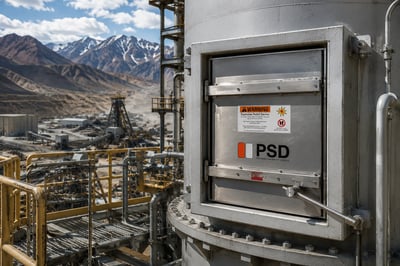
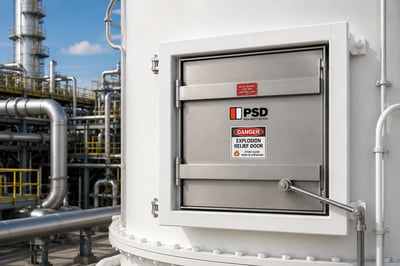
Explosion relief doors, sometimes called rupture doors, are reusable pressure relief devices designed to open when internal vessel pressure reaches a predetermined set point.
The doors are mounted directly to the vessel and utilize calibrated release mechanisms to control opening pressure.
Common explosion relief door configurations include:
- Reusable doors
- Self-reclosing doors
- Non-self-reclosing doors
- Self-destructive doors
Additional options may include:
- Open-door monitoring switches
- Door opening stops
- Access cages
- Custom mounting arrangements
Advantages of Explosion Relief Doors
Explosion relief doors offer several advantages:
- Reusable after activation
- Lower replacement costs
- Reduced downtime
- Visual access to vessel interiors
- Long service life
After a pressure event, most reusable explosion relief doors can be reset and returned to service rather than replaced.
Explosion Vents
Explosion vents, commonly referred to as rupture discs or rupture panels, provide another method of relieving pressure.
These devices utilize a thin metal membrane designed to rupture when internal pressure exceeds a predetermined level.
Explosion vents are available in several configurations:
- Square
- Rectangular
- Round
- Domed
Many designs incorporate engineered score lines that help control the vent opening pattern during activation.
Advantages of Explosion Vents
Explosion vents offer several benefits:
- Extremely fast response times
- Minimal opening inertia
- Suitable for a wide range of vessel sizes
- Effective for many dust and gas applications
Limitations of Explosion Vents
Unlike explosion relief doors, explosion vents are generally single-use devices.
After activation:
- The vent must be replaced
- Production may remain offline until replacement occurs
- Maintenance personnel may require access to difficult-to-reach locations
Regular inspections are also necessary to identify fatigue, corrosion, or damage that could affect performance.
Vacuum Relief Valves
Vacuum relief valves protect vessels from pressure imbalances that occur during filling, emptying, cooling, or other process conditions.
These valves open automatically when pressure reaches a predetermined level.
In many applications, vacuum relief valves are used alongside other explosion protection technologies rather than as a standalone explosion mitigation solution.
Typical Vacuum Relief Valve Applications
Vacuum relief valves are frequently installed on:
- Storage tanks
- Silos
- Dust collectors
- Process vessels
- Bulk material handling systems
They help prevent vessel collapse caused by excessive vacuum conditions.
How to Choose the Right Explosion Relief Device
Selecting the appropriate explosion relief device depends on several factors.
Downtime Considerations
Facilities that prioritize rapid recovery after an event often prefer explosion relief doors.
Because the doors can be reset rather than replaced, operators can often restore service more quickly than with rupture panels.
Pressure Requirements
Explosion relief doors typically operate within a specific pressure range.
Applications outside those parameters may require alternative technologies such as rupture vents or specialized relief systems.
Accessibility
Maintenance accessibility can influence device selection.
If a vessel is difficult to access, replacing rupture panels after activation may create operational challenges.
Reusable explosion relief doors may offer advantages in these situations.
Visibility Requirements
Some operations benefit from the ability to visually inspect process conditions through the relief device.
Explosion relief doors can provide this capability, whereas rupture vents generally do not.
Process Conditions
Environmental factors also influence device selection:
- Temperature
- Corrosion exposure
- Humidity
- Product characteristics
- Dust explosibility
- Gas composition
These variables help determine which materials and designs are appropriate.
Standards and Regulations Governing Explosion Relief Devices
Explosion relief devices are often governed by multiple standards, regulations, and authorities.
NFPA Standards
The National Fire Protection Association (NFPA) publishes several standards related to explosion protection, including:
- NFPA 68
- NFPA 69
- NFPA 652
- NFPA 654
- NFPA 61
- NFPA 484
- NFPA 664
These standards help establish requirements for explosion prevention and mitigation.
FM Approvals
Factory Mutual (FM) provides testing and certification programs that evaluate explosion protection equipment and system performance.
OSHA and MSHA
Depending on the industry, facilities may also be subject to requirements established by:
- OSHA
- MSHA
Authority Having Jurisdiction (AHJ)
The local Authority Having Jurisdiction often has final approval authority regarding safety system requirements and code compliance.
Which Explosion Relief Device Is Right for Your Facility?
There is no universal solution for explosion protection.
The optimal device depends on:
- Process conditions
- Equipment design
- Operating pressures
- Maintenance requirements
- Regulatory obligations
- Downtime considerations
An experienced explosion protection manufacturer can help evaluate these factors and recommend the most appropriate solution.
Need Help Selecting an Explosion Relief Device?
PSD designs and manufactures explosion relief doors, explosion vents, vacuum relief valves, and custom pressure relief solutions for industrial applications worldwide.
Whether you're designing a new system or upgrading existing equipment, our team can help identify the right solution for your process and safety requirements.
Contact PSD today to discuss your application.