Understanding the Transition from Deflagration to Detonation
Introduction
Industrial facilities that process combustible dusts, gases, vapors, or powders face a variety of explosion hazards. Among the most important concepts in explosion protection are deflagration and detonation.
While the two terms are often used interchangeably, they describe very different combustion events. Understanding the distinction is critical for facility operators, engineers, and safety professionals responsible for protecting personnel and equipment.
In some circumstances, a deflagration can transition into a detonation, creating significantly greater pressures and a much higher risk of catastrophic damage.
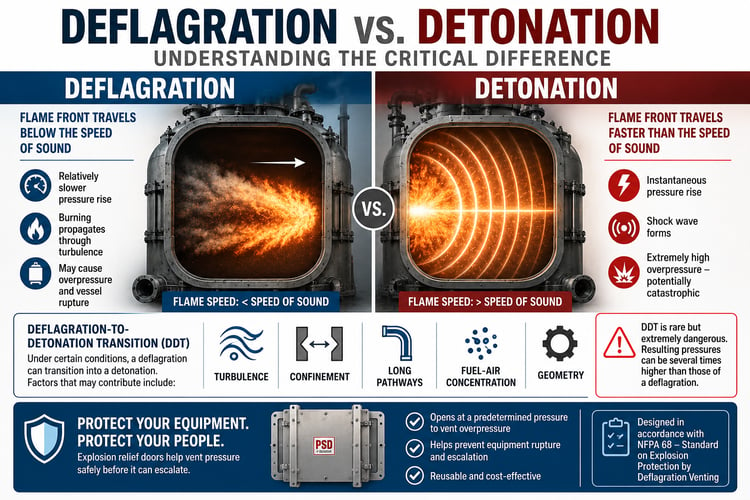
%20Explained.png?width=1024&height=1536&name=Deflagration-to-Detonation%20Transition%20(DDT)%20Explained.png)
What Is Deflagration?
Deflagration is a combustion process in which a flame front travels through a fuel-air mixture at a speed below the speed of sound.
As the fuel burns, heat transfers to surrounding material and continues propagating the flame front through the combustible mixture.
Deflagration can occur with:
- Combustible dust
- Natural gas
- Propane
- Chemical vapors
- Solvent vapors
- Fine powders
Although often described as a "slow" explosion, industrial deflagrations can still generate significant overpressure and cause extensive damage.
Everyday Examples of Deflagration
Many familiar combustion processes are examples of deflagration.
Gas Stoves
When natural gas burns on a household stove, combustion occurs through a controlled deflagration process.
Propane Grills
The flame generated by a propane grill is another common example.
Internal Combustion Engines
Gasoline engines rely on controlled deflagration to generate power and move vehicle pistons.
Combustible Dust Demonstrations
Many safety demonstrations involve dispersing flour or powdered sugar into a flame. The resulting fireball demonstrates how rapidly combustible dust can burn when suspended in air.
The Deflagration Process in Industrial Facilities
Industrial deflagrations become particularly dangerous when combustion occurs within an enclosed vessel or piece of equipment.
Examples include:
- Dust collectors
- Cyclones
- Process vessels
- Silos
- Conveyors
- Bucket elevators
As combustible material burns, expanding gases create pressure inside the enclosure.
If the pressure exceeds the structural strength of the equipment, a rupture or explosion can occur.
What Is Detonation?
Detonation is a combustion process in which the flame front travels faster than the speed of sound.
Unlike deflagration, detonation creates an intense shock wave that compresses and ignites material ahead of the flame front.
The resulting pressure rise occurs almost instantaneously.
Because of these extreme pressures, detonation events are typically far more destructive than deflagrations.
Deflagration vs. Detonation
The primary difference between the two processes is flame speed.
Deflagration
- Flame travels below the speed of sound
- Pressure rises relatively gradually
- Common in industrial dust and gas incidents
- Often manageable through proper explosion protection systems
Detonation
- Flame travels faster than the speed of sound
- Produces a shock wave
- Creates significantly higher pressures
- Can result in catastrophic equipment failure
In many situations, detonation pressures can be several times greater than pressures generated during deflagration.
Can a Deflagration Become a Detonation?
Under certain conditions, yes.
This phenomenon is known as Deflagration-to-Detonation Transition (DDT).
Although relatively uncommon, DDT is one of the most dangerous explosion scenarios encountered in industrial environments.
Factors that may contribute to DDT include:
- Long enclosed pathways
- Congested equipment layouts
- Highly turbulent flow conditions
- Specific fuel-air concentrations
- Confinement
- Process geometry
As turbulence increases, flame speeds may accelerate dramatically.
In rare circumstances, the flame front can accelerate enough to transition into detonation.
Historical Examples of Large-Scale Explosion Events
Several well-known industrial disasters involved combustion events that generated devastating overpressures.
Examples often cited by safety professionals include:
- The Phillips Petroleum explosion
- The Port Hudson vapor cloud explosion
- The Beirut port explosion
These incidents illustrate the importance of understanding explosion hazards and implementing appropriate protection systems.
Why Explosion Protection Matters
The goal of explosion protection is to prevent pressure from reaching levels capable of damaging equipment or endangering personnel.
A comprehensive explosion protection strategy may include:
- Hazard analysis
- Housekeeping programs
- Explosion venting
- Explosion isolation
- Suppression systems
- Pressure relief devices
Properly designed systems can significantly reduce the consequences of a combustion event.
How Explosion Relief Doors Help Reduce Risk
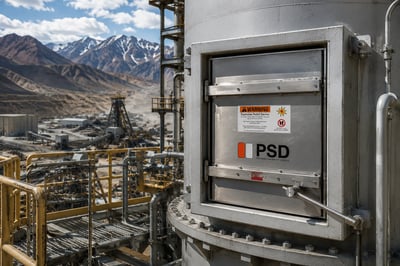
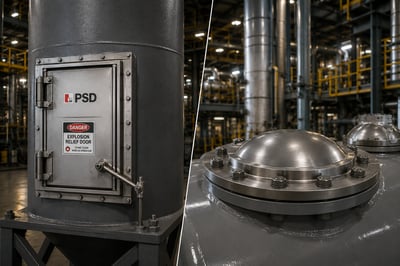
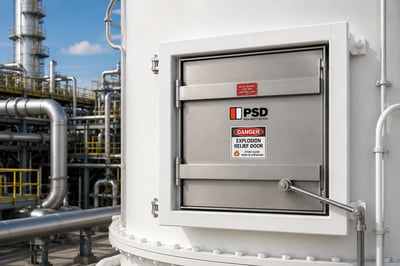
Explosion relief doors are designed to open at a predetermined pressure before dangerous overpressure conditions develop.
By relieving pressure early in the event, explosion relief doors help prevent pressure from escalating to levels that could damage equipment or create more severe consequences.
Benefits include:
- Controlled pressure relief
- Reduced equipment damage
- Reduced downtime
- Reusable operation
- Compliance with applicable industry standards
Reusable explosion relief doors are commonly used on process vessels, dust handling equipment, and other industrial applications where pressure relief is required.
NFPA Standards and Deflagration Venting
The National Fire Protection Association (NFPA) publishes standards that address explosion protection and deflagration venting.
One of the most frequently referenced standards is NFPA 68, which provides guidance on explosion protection by deflagration venting.
These standards help engineers determine:
- Vent sizing
- Opening pressures
- System design considerations
- Equipment protection requirements
Facilities should work with qualified engineers and safety professionals to ensure compliance with applicable regulations and standards.
Protecting Your Facility from Explosion Hazards
Understanding the difference between deflagration and detonation is an important part of any industrial safety program.
While detonation events are less common, the potential consequences are severe. Proper explosion protection systems can help reduce risk, protect personnel, and minimize damage to critical equipment.
Whether your facility handles combustible dust, powders, gases, or vapors, a proactive approach to explosion protection is essential.
Need Help Evaluating Your Explosion Protection Strategy?
PSD designs and manufactures explosion relief doors, explosion relief vents, and vacuum relief valves for industrial applications worldwide.
Our team can help evaluate your process conditions and recommend explosion protection solutions that support both safety and operational reliability.
Contact PSD today to discuss your application.