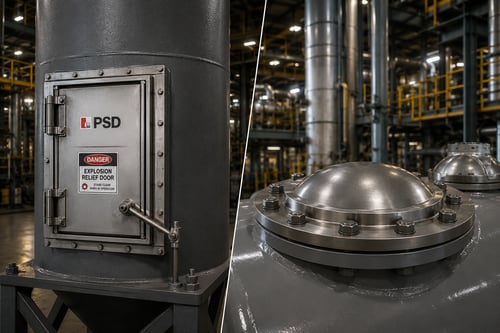
Safety Door Mounting Options
Mounting the Door Assembly
PSD explosion relief doors can be mounted in any position, with the hinge axis vertical, horizontal (top or bottom of door) or angled. The opening required in the housing is equal to the actual door size plus either 6 or 9 inches in both the length and width dimensions. See the door frame table above.
Safety Door Sizing
Standard Door Panel Sizes
| Panel Width (inches/mm) | Panel Height (inches/mm) | Opening Area (square feet) |
| 24 / 0.6096 | 24 / 0.6096 | 4.0 / 0.372 |
| 21 / 0.533 | 21 / 0.533 | 3.06 / 0.284 |
| 21 / 0.533 | 45 / 1.143 | 6.56 / 0.609 |
| 12 / 0.305 | 12 / 0.305 | 1.0 / 0.093 |
Door Frame Sizing
| Frame Width | Inside Height A | Inside Width B | Outside Height C | Outside Width D |
| 3 inches | A | B | A + 6 | A + 6 |
| 4.5 inches | A | B | A + 9 | A + 9 |
Sizing if you calculated the minimum area required
If you know the door area based on the applicable Standards, processed materials, vessel size, strenght and configuration you may be able to use a standard door size or request a custom door size.
We will calculate the door size if you don’t know the minimum area required
The number and size of complete doors required is a function of the vent ratio for the particular application (vent ratio is the ratio of pressure relief area required to the total volume enclosed in the housing or vessel). We can calculate the minimum area required from the current standards in your area.
Safety Door Features
- 3000 Series aluminum
- These standard stainless steels: 304, 316
- Ask for special stainless steel alloys and these options:
- 2B Mill Finish
- Material Certifications
- Identification Labels
Door Panel Temperature Ranges
- This depends on the internal construction of the door panel and gasketing used
- Standard industrial grade up to 400F (204C)
- Hi-Temp industrial grade up to 1000F (538C)
- Special industrial grade up to 1490F (810C)
Frame and Door Panel Materials
- 3000 Series Aluminum
- Standard Stainless Steels: 304, 316
- Special Stainless Steel Alloys Also Available: 301/302, 310, 347
Frame Styles
- Bolt-on or weld-on
- 3" wide or 4.5" wide - custom designs available
Gasket Types and Temperature Ranges
- SBR Rubber, Black or White -20 F / 212F
- Buna-N Nitrile, Black -30 F / 250 F
- Silicone Rubber, White -80 F / 420 F
- Using FDA recognized (food grade) components, beveled or square profile
- Using non-FDA recognized (non- food grade) components, square profile
- Silicone Rubber, White Food Grade, 2-part interlocking gasket system -80 F / 420 F
- Viton, Black -10 F / 400 F
- Woven Silica to 1500F
Special Options
- Thermal Insulation
- 5.4 .hr-ft²-ºF/Btu
- Protective Cages
- Solid bar construction
- Retraint Cables
- Aircraft Cable, 1/8th Dia, Braided Stainless Steel
- Alarm Switches for Remote Indication of Door Opening
- 4X, 7X, Haz Loc NEC 501 rated, ATEX rated
- Strip Heaters to Prevent Icing
- Factory installed or shipped loose
- Field Calibration Fixture
We Do Not Use Conflict Materials
Section 13(p) of the Securities Exchange Act of 1934 and Rule 13p-1 thereunder (collectively, the “conflict mineral rules”) require Philadelphia Safety Devices (PSD) to make certain disclosures concerning supply sources for conflict minerals – principally consisting of gold, tin, tungsten, or tantalum – that may be necessary to the manufacture or functionality of our products.
Philadelphia Safety Devices neither uses nor adds any conflict materials to make their products
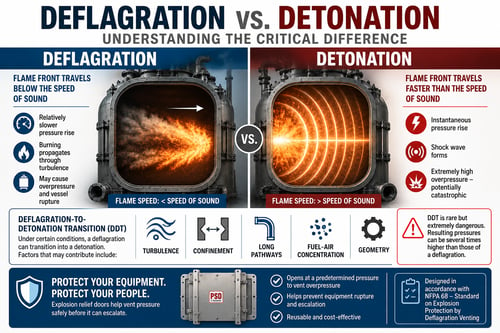
Deflagration vs. Detonation: Understanding the...
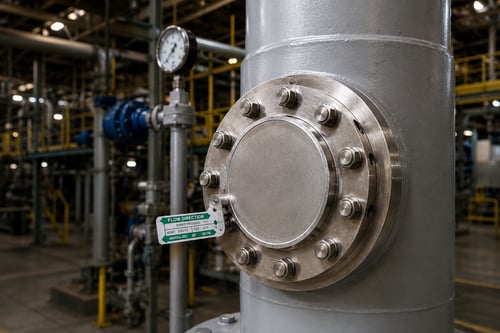
Common Rupture Disc Problems and How to Avoid Them