

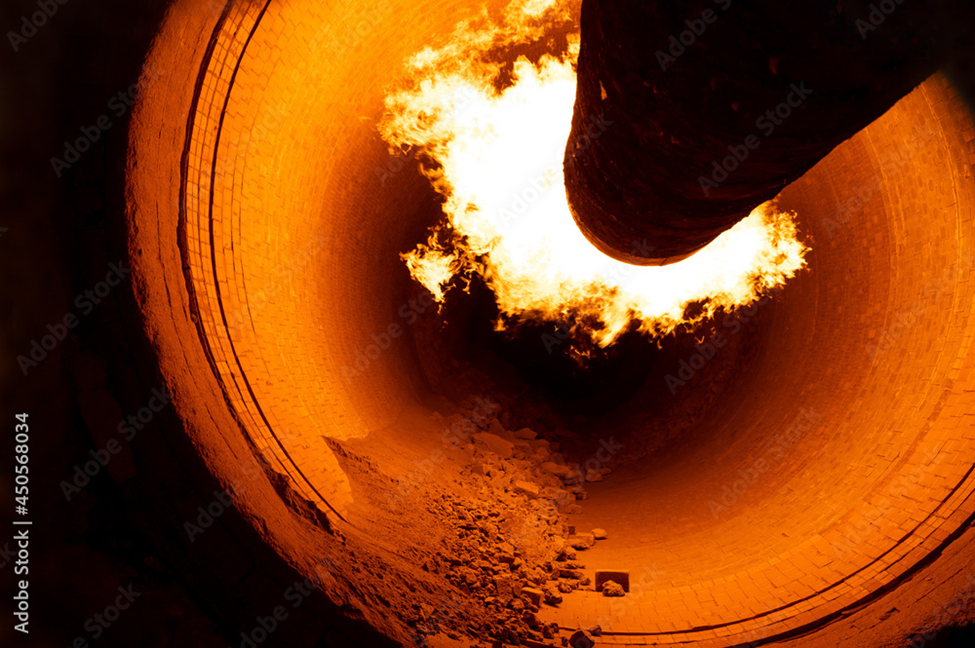
When a rotary kiln explodes the results are usually devastating. Key production machinery will be out of service for months, but more importantly, there’s a very real risk to those working nearby of serious injury and even death.
Avoiding such events takes a combination of actions. It’s vital to understand and manage rotary kiln explosion risks. Personnel responsible for the kiln must be trained appropriately, and sensor technologies and controls must be implemented. In addition, thoughtfully designed and installed explosion relief doors and vents can mitigate the force of an explosion and so reduce its seriousness.
AN OVERVIEW OF ROTARY KILNS
Many common materials – cement, vermiculite, and titanium dioxide to name three – are made by calcination. This is a heating process that drives off some constituents of granular material to turn it into something else. The best-known example is processing limestone for cement production. Here, temperatures of around 1,000° C (1,922° F) remove carbon dioxide from the raw material to leave calcium oxide.
Industrial-scale calcination is done as a continuous process, using a rotary kiln. This is essentially an inclined tube that rotates slowly about its axis, (typically around 5 rpm,) as hot gas is injected.
In most designs, raw material is dropped into the top of the tube and rotation moves it downwards while it’s heated by the hot gas. Processed material drops out from the lower end of the kiln while gasses are given off by the material left at the higher end. In many designs, as an energy-saving measure, these gases are used for preheating the material or the reaction gases.
In most rotary kilns heating is done by gas. This may be either direct, where the burner is at the lower end of the tube, or indirectly. In an indirect system, the burners heat a gas that is then blown into the kiln.
ROTARY KILN EXPLOSION RISKS
On December 25th, 2018 a rotary lime kiln exploded at a factory in China. Seven people died, many more were injured and the economic costs were put at 22 million yuan ($3.5 million.)
The subsequent investigation determined that the direct cause was the ignition of a gas and air mixture in the kiln. Before lighting the burner an essential safety step is to purge the kiln of air. In this case, air remained, and when the burner was lit the mixture exploded.
Such explosions are not uncommon. They can occur in both direct and indirect systems and result from the ratios of the gases present, combined with heat and pressure, Incomplete combustion and dust build-up are often contributing factors.
PREVENTING ROTARY KILN EXPLOSIONS
Prevention requires a combination of worker training and appropriate instrumentation. All those with responsibility for the operation or maintenance of a rotary kiln must be educated in the risks and trained in safe operation. Start-up procedures should be a particular focus as this is a time when gas may flow without being ignited.
The required instrumentation includes:
- Air pressure measurement
- Inlet temperature measurement
- Gas flow rate
- Gas pressure at the outlet
- Outlet humidity
- Air pressure switches
- Gas pressure switches
- Flame detectors
- Gas analyzers
- Safety shutoff valves
These should all be incorporated into a control system that inhibits or quickly shuts down operations when any unsafe conditions are detected.
A particular challenge in designing and implementing these control systems is ensuring they can respond quickly enough to any changes in conditions. In particular, some gas analyzers are unable to react fast enough to be useful.
EXPLOSION MITIGATION IN ROTARY KILNS
If gas levels get out of balance in a rotary kiln it can be very difficult for the control systems to respond quickly enough to prevent an explosion. For this reason, it’s essential to incorporate explosion relief doors and vents.
Explosion relief doors and vents are devices engineered to open rapidly in response to a sudden change in pressure. This provides the rapidly expanding gas with a safe means of escape, so ensuring the sudden and dramatic rise in pressure doesn’t destroy the kiln itself or associated systems.
Explosion relief vents are single-use devices. They are designed to give way quickly before pressure rises to a damaging level. In contrast, explosion relief doors are designed to be reusable. This is achieved through a combination of lightweight (and therefore low inertia,) materials with fast-acting latches. A small increase in pressure triggers the latch which lets the door spring out quickly.
EXPERT ADVICE RELIEF SIZING
An explosion relief door or vent that’s too small or responds too slowly is not going to protect a rotary kiln, or the people around it, from an explosion. Given the very real risk of an explosion, safety depends on acting on the advice of specialists with a deep understanding of these devices.
Our specialists will be glad to review your process – rotary kiln or other – and advise on the size and types of doors, hatches, or vents to use. Why take chances on safety?